VIGAN

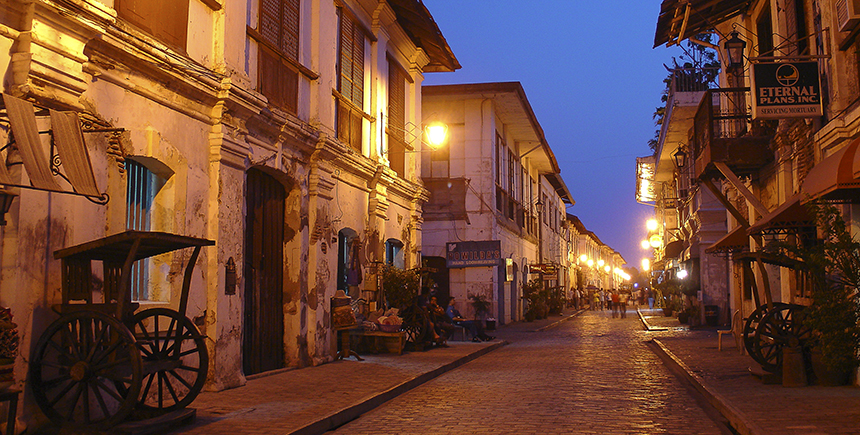
Vigan (IlocanoSiudad ti ViganTagalogLungsod ng Vigan; Local pronunciation: [ˈbigän]), officially the City of Vigan, is a 4th classcomponent city and capital of the province of Ilocos SurPhilippines. According to the 2015 census, it has a population of 53,879 people.

Located on the western coast of the large island of Luzon, facing the South China Sea, it is a UNESCO World Heritage Site and it is one of the few towns left in the Philippines whose old structures have mostly remained intact, and it is well known for its settpavements and a unique architecture of the Philippine colonial era which fuses Native Philippine and Oriental building designs and construction, with colonial Spanish architecture that is still abundant in the area, mainly the Bahay na Bato houses and anEarthquake Baroque church. Former Philippine president Elpidio Quirino, the sixth President of the Philippines, was born in Vigan, at the former location of the Provincial Jail (his father was a warden); he resided in the Syquia Mansion. The entire city of Vigan was later inscribed as a UNESCO World Heritage City after being declared as a UNESCO World Heritage Site. It is a member of theOrganization of World Heritage Cities (OWHC).

In May 2015, Vigan City was officially recognized as one of the New7Wonders Cities together with BeirutDohaDurbanHavana,Kuala Lumpur and La Paz.[4] New7Wonders Foundation president and founding member Bernard Weber led a ceremony held atSt. Paul Cathedral where he handed a bronze plaque to Vigan Mayor Eva Grace Singson-Medina, signifying the heritage city’s election as one of the world’s wonder cities.
RICE TERRACES

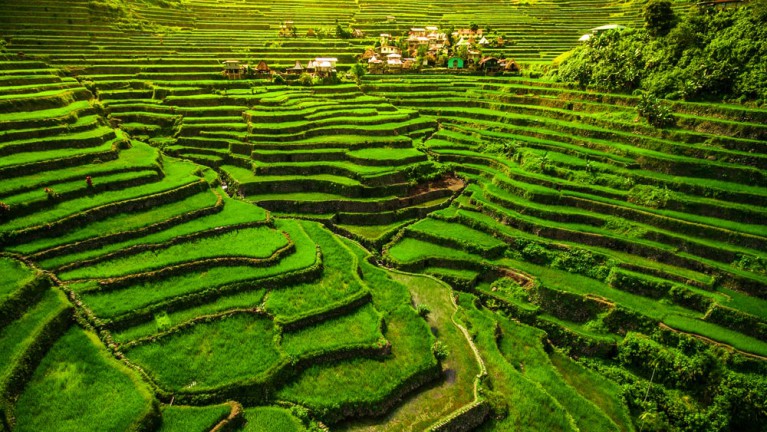
The Banaue Rice Terraces (FilipinoHagdan-hagdang Palayan ng Banawe) are terraces that were carved into the mountains ofIfugao in the Philippines by the ancestors of the indigenous people. The terraces are occasionally called the “Eighth Wonder of the World“.[1][2][3] It is commonly thought that the terraces were built with minimal equipment, largely by hand. The terraces are located approximately 1,500 metres (4,900 feet) above sea level. These are fed by an ancient irrigation system from the rainforests above the terraces. It is said that if the steps were put end to end, it would encircle half of the globe.

Locals up to this day still plant rice and vegetables on the terraces, although more and more younger Ifugaos do not find farming appealing,often opting for the more lucrative hospitality industry generated by the terraces. The result is the gradual erosion of the characteristic “steps”, which require constant reconstruction and care. In 2010, a further problem encountered was drought, with the terraces drying up completely in March of that year.

Anthropologist Otley Beyer has estimated that the terraces are over 2000 years old, but several researchers dispute this and contend that they were built much later.[There are also giant earthworms (“olang” in Ifugao) of the genus Pheretima or Polypheretima elongata which are blamed for causing damage to the terraces, as well as rodents of the genus Chrotomis mindorensis, and snails.

BORACAY

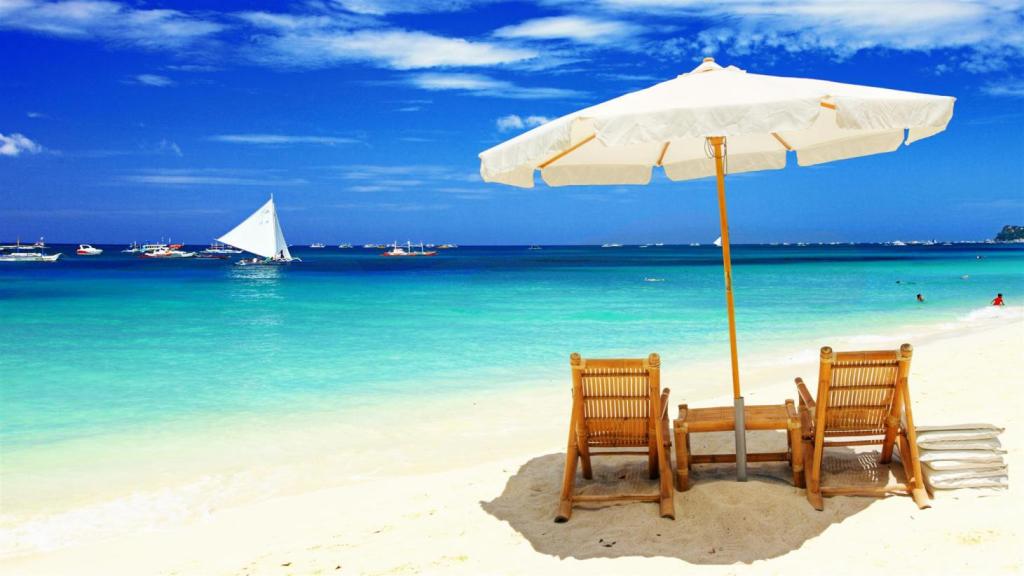
Boracay is a small island in the Philippines, 7 km long and 1 km wide, located approximately 315 kilometres (196 miles) south ofManila and 2 kilometres (1.2 mi) off the northwest tip of Panay Island in the Western Visayas region of the Philippines. Boracay has a populace of 32,267 individuals last recorded since February 2016. Boracay Island and its beaches have received awards from numerous travel publications and agencies.[Note 1] The island comprises the barangays of Manoc-Manoc, Balabag, and Yapak in themunicipality of Malay, in Aklan Province. The island is administered by the Boracay Inter-agency Task Force. Apart from its white sand beaches, Boracay is also famous for being one of the world’s top destinations for relaxation. As of 2013, it was emerging among the top destinations for tranquility and nightlife.

Boracay was awarded as the 2012 Best Island in the World by the international travel magazine Travel + Leisure. In 2014, the resort island was at the top of the “Best Islands in the World” list published by the international magazine Condé Nast Travele. In 2016, Boracay headed the magazine’s list of “Top 10 destinations to watch”.

In April 2018, the Philippine Government decreed a 6-month closure of the island for tourists to undertake major renovation works, especially of the sewage system, which had become obsolete and insufficient. It re-opened in October 2018, with a set of new rules meant to address a variety of issues

Design a site like this with WordPress.com
Get started